You might not have heard about it yet, but the fruit – golosa – shows a trend of increasing popularity. It is one more option in the richly varied menu of Amazonian fruits that, little by little, is being discovered by the people of the region. The fruit is already highly sought-after in the southwest of Pará, especially in the municipality of São Félix do Xingu.
This species is predominant on the banks of the Xingu and Fresco rivers. It has been cataloged under the scientific name Chrysophyllum cuneifolium and has acidic and sweet flavor, which, for some, approaches that of cupuaçu, while for others it holds more similarities with graviola [soursop]. It is an oval-shaped fruit, that weighs between 250 and 300 grams. Golosa may have from one to four seeds – and can be turned into candy, mousse, juice and whatever else the gastronomic imagination is able to reach.
The annual production of the fruit fluctuates between 10,000 and 15,000 kilos and most of it is consumed by São Félix do Xingu residents. It is estimated that the production will start to gain scale, since it has evolved from the restrict native golosais areas to a large number of plantations scattered throughout the region.
In the North region, the fruit has also been identified in the states of Amapá and Amazonas. Among the communities along the Fresco river, golosa is traditionally consumed, incorporated into the daily diet of families and highly appreciated. There, the peculiar name is thought to have emerged: the fruit is so delicious that it awakens the gluttony of those who consume it.
UNIQUENESS
Mario Gomes da Silva - rural extensionist and Technical Assistance and Rural Extension Company (Emater) in São Félix do Xingu – recalls that the role of golosa goes beyond feeding. "It is an ideal planting for the recovery of forests, as this species adapts very well to the banks of rivers and streams. The tree that can reach up to 30 meters height. So, in addition to recovering degraded areas, it can be used for shading cocoa", explains Mario. This function of the golosa tree is important because Emater data indicate that 104 hectares of degraded land need to go through the recovery process in São Félix do Xingu.
The productive potential of golosa is also a competitive differential, in Mario's view. "It's a source of income that is worth investing, because during the harvest a lot of money is generated from the fruit and the pulp itself. Demand is high in the region. The harvest starts in December and can last until February. From 2020 to 2023, approximately 15,000 seedlings were distributed and we want to reach 20,000 by 2024. The main challenge is to increase production and expand the planted area. It is a huge mission, but one that will have many advantages and returns in terms of job offer and income generation and also in the recovery of degraded areas. I see that growth is a matter of culture, as cocoa is already very consolidated in the region. I believe that the golosa will follow the same path: a single tree, adult and native, can produce 500 kilos of golosa per year. In addition, the production starts, on average, from five years after planting. It has all the conditions to grow and become the cue ball", bets Mario.
Production and commercialization of fruits unite women in association
Resident Josefa Machado became interested in planting fruit seedlings in the mid-2000s, a period when her farm did not even have electricity. She joined the producers' association in the municipality of São Félix do Xingu and started planting cocoa. But her property was engulfed in a fire in 2007 and the entire plantation was burned. In another farm, Josefa persisted with the idea of working with the cocoa planting and sale. That's when golosa came into her life. Today, Josefa presides over the Associação das Mulheres Produtoras de Polpas de Frutas de São Félix do Xingu [Women Association of Fruit Pulp Producers in São Félix do Xingu], an entity that already possesses 55 members.
"Since we formed the association and started selling golosa, this has become an extra income for the family, meaning more independence for the women producers. Producing something of your own and selling it is synonymous with autonomy, it helps us to carry out our plans, projects, dreams... Before, we had more milk and cocoa production, that is, something not very diversified. Today, everything planted in our backyards can be used. It is what maintains the properties. I am happy to see the interest in golosa. This fruit has the face of the Xingu. It is already very sought after by people who come from outside. It used to be only native, but, now, we already have plantings, and within ten years of cultivation it is already able to produce in abundance. The golosa has a strong smell , native, different... Recognition outside the city still needs to grow further, because those who don't know and try it, always love it", guarantees the producer.

Josefa says that the golosa plantations in the region started with her and a neighbor, as her husband was very familiar with the fruit, that is now part of the agroforestry system that their family takes care of. Josefa remarks that the golosa needs to be scalded before being handled, making it easier to extract the milk from the fruit.
"If you don't scald it, even when it's time to make the juice, it will stick to the glass, it makes a bond... It has to be scalded. There are those who eat the pure fruit, make mousse or blend it like a smoothie. It's delicious anyway", explains Josepha.
ADVERTISING
Producer Josefa Machado believes that the commercial potential of the fruit is immense but that golosa needs to be better promoted. Besides, there are other challenges to ensure large-scale production of the fruit in natura and pulp. "We still waste a lot of fruit because we can't harvest everything in a short period. There's also the problem of lacking a cold storage room, which would be ideal to guarantee the preservation of large quantities of fresh golosa fruit and pulp to start sales to buyers from outside the municipality. We also need to increase processing capacity as many golosa plants that were planted a few years ago will soon bear fruit. These crops will require more processing," she says.
Research points out that species is rich in nutrients
Even if one uses the internet, they find little information about the golosa. The fruit has gradually become the object of studies in different areas. Food engineer Flávio Santos has dedicated himself to better understand the components and characteristics of the species. According to him, initial studies already show the high nutritional potential of the fruit.
"It's a fruit rich in nutrients. Laboratory analyzes already evidence high presence of citric acid, as well as ascorbic acid, vitamin C and fiber. Lots of fiber. We were able to map the fruit physically and chemically and even found a lot of evidence of nutrients with potential for the pharmaceutical industry, a classic use in the Amazon region. We are also researching possible by-products, an open path for possibilities beyond food", explains Flávio.
"We also know that a lot of golosa is lost due to competition with animals in the forest. It falls to the ground and attracts animals around the plant, and when it's collected, it's often heavily bitten. Another interesting fact is that it has a fleshy mass ranging from 75% to 80%, which is considered high. Its pulp is easy to extract and handle," reports Flávio.

Vanessa Kiua Macedo, from Universidade Federal do Sul e Sudeste do Pará, is the author of a study on taxonomic determination of golosa. She states it is a rare species and, therefore, should be a priority in conservation efforts. She also explains that the Sapotaceae family, to which golosa belongs, presents several taxonomic challenges, because there are various groups of species with undefined boundaries and statuses, but there are three subspecies of golosa. The species she studied were collected during her investigation and recorded under the name Chrysophyllum cuneifolium, representing the first botanical record of the species in São Félix do Xingu.
"Due to the increase of deforestation in the Amazon, especially in São Félix do Xingu, the golosa crops are under threat. This fact could lead the species to the risk of local extinction. Because of the advanced deforestation in this region, alternatives are being sought for the conservation of the species, as taxonomic studies form the basis for their conservation, as it is necessary to know about it in order to preserve it. Besides understanding the species, it is important for diversity studies to have a record of the species in the region, through botanical collection and preservation of its exsiccata (dried, identified, and stored plant specimens in herbaria)," she says.
City hall and Imaflora support the production.
Marlos Peterle, the Municipal Secretary of Agriculture in São Félix do Xingu, believes that the fruit can gain global appeal due to the so-called "Amazon" brand. He says that the fruit is successful at industry fairs, and even an ice cream company in Belém has shown interest in it, but fulfilling significant volume orders is still a challenge. "It's a seasonal fruit, so, having large quantities throughout the year is impossible. But now, that commercial plantations have started, this will change. I believe we will be able to boost the fruit," explains Marlos.
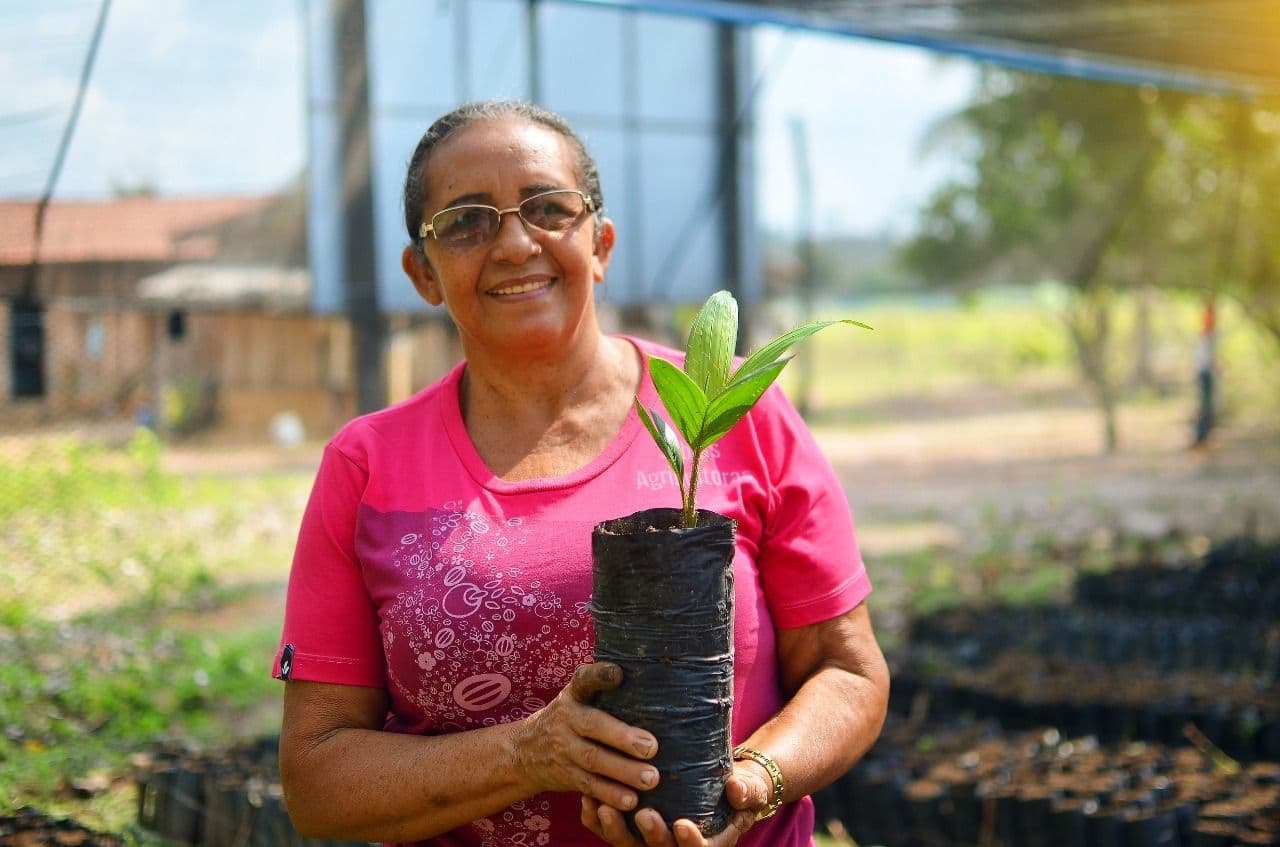
Currently, the agriculture department encourages the consumption of the pulp in school meals and their main concern is the production of seedlings for distribution, with annual collection of the seeds in the native golosa plantations. "We harvest the fruit and partner with the association of producers. In the nursery, we germinate the seeds for the seedlings, with free distribution and focus on cocoa agroforestry systems, which need shading. So, for those who already plant cocoa, this activity becomes a second source of income. We want to share the seedlings with as many producers as possible", says the secretary.
Today, an average of 150 to 200 producers receive around eight and ten thousand seedlings per year. The fruiting period reaches eight years and prices vary between R$ 10 and R$ 20 Reais per can. At the peak of production, the fruit is cheaper, with many riverside people dedicating themselves to harvesting.
"In the future, we hope to work with grafting systems to expand golosa production and make the fruit more economically viable, in addition to seeking partnerships with people who can increase the reach of the products", says Marlos.
Marketing
Project analyst Celma de Oliveira, from Forestry and Agricultural Management and Certification Institute, believes that all golosa needs to take off is a little more marketing.
"Whenever we visit the communities, we see an increase in the interest in golosa by farmers. We already see residents from other municipalities in the region of the PA-279 highway traveling to São Félix do Xingu to buy the fruit. The women's association already has an artisanal product stamp issued by the Agricultural Defense Agency of the State of Pará, and golosa is the 14th fruit that they make pulp. In other words, this diversifies production, generating jobs, income and preservation", says Celma.