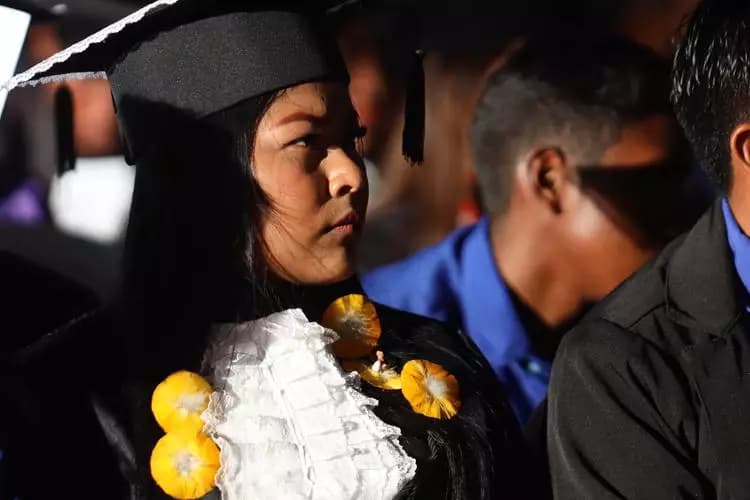
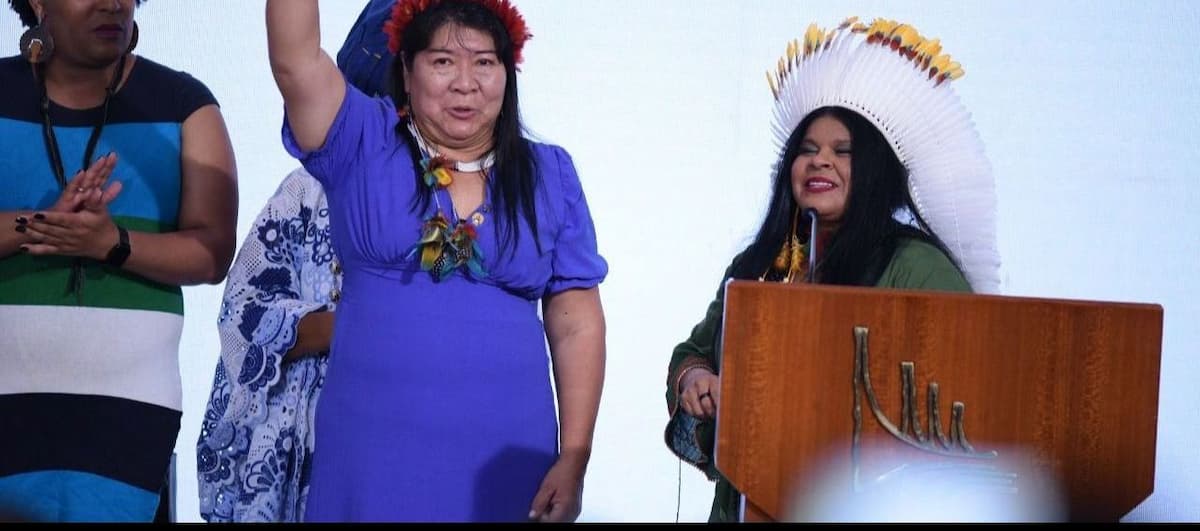
The presence of traditional communities in universities is still new and full of challenges, but members of these communities are fighting for their space to build a more plural and knowledge-rich academia. The 23-year-old Tel Guajajara, who goes by the indigenous name Awaité, has been standing out among the movements and showing the importance of representation.
Tel Guajajara is a law student at the Federal University of Pará (UFPA), Director of Culture at the National Union of Students (UNE), Coordinator of the Curupira Circuit and a member of the Brazilian Coalition for Climate Education.Tel says that being in places as an indigenous person is undoubtedly challenging, as he still suffers racism in many places, including those where he is invited, but he highlights the progress he has made, as he has been breaking down stereotypes about what people think of him and of indigenous peoples. "I don't just discuss one agenda, I'm an indigenous person who debates across the board in Brazil. I occupy a place that has always been ours and that I now occupy by right. Never again a Brazil without us," he says.
He points out that "Amazon Dialogues" opened up a range of opportunities to understand other realities in the Amazon(s), a large place with many particularities. "It was fundamental for us to present new agendas and reformulate the ones we have. We need to find a collective solution for our region. This accumulation is fundamental for the reconstruction of Latin America as a whole," she reflects. A novelty in this program was the proposal made by the UNE together with the Latin American and Caribbean Continental Student Organization (OCLAE) and the National Association of Graduate Students (ANPG) to the president of the Summit: the creation of an Integrated University of the Amazon, a strategic initiative to unite traditional and ancestral knowledge with the current university model."We want to use science to guarantee our protected territory. This university would help to think up new forms of education and give new prospects for the future to the peoples of the Amazon. Ensuring that we fight hunger with new techniques is one of them, guaranteeing the technology we already have with the university to clean up the waters and guarantee a clean energy transition, we can be these scientists of our own territories," explains Tel Guajajara. In the face of all this debate, the young indigenous man hopes for good results, since he and his community have been trying to make an effort to understand realities and challenge themselves, to present public policies.
"Belém has become the center of the world with these debates, and it's up to us to hold the state accountable for implementation and also to blame those who degrade our territory. Yes, we have to charge those countries that pollute our environment the most, which is why the fight to make climate education compulsory is fundamental in schools and universities to raise awareness. This is also directly linked to land demarcation and the right to live," he adds. Almires Martins Machado, a visiting professor at UFPA's Institute of Legal Sciences for undergraduate and postgraduate studies, is from the Guarani Terena ethnic group. He was born in the village of Jaguapiru, in the state of Mato Grosso do Sul. He has a degree in Law, a master's degree in Human Rights and a doctorate in Anthropology. He explains that the importance of traditional communities being in universities is that it brings to the academic world other epistemologies, other philosophies and, among them, the good life and dignity of traditional communities."When we bring this knowledge into the classroom we are bringing, among other things, another authority, another epistemology, another philosophy. Another way of understanding the world and seeing the world in another way, seeing law, seeing medicine, seeing history, seeing geography, even seeing physics," explains the professor.The professor also points out that academia has a certain resistance to recognizing traditional knowledge as knowledge. "And here you have two forces: empirical knowledge came up against typical knowledge, which is the kind of knowledge that is based on scientific methodology. And academia was reluctant to recognize this knowledge and this was one of the problems faced since Eco-92, which was discussed at the UN," he adds.
Almires Machado explains that the traditional knowledge associated with biodiversity, for example, is that which is found in the villages, quilombos, among the riverside dwellers, extractivists and indigenous peoples and others who would answer, for example, how to preserve the planet, conserve the planet, the forests, the rivers, in order to have a quality life and medicines, which today can cure the world's diseases.