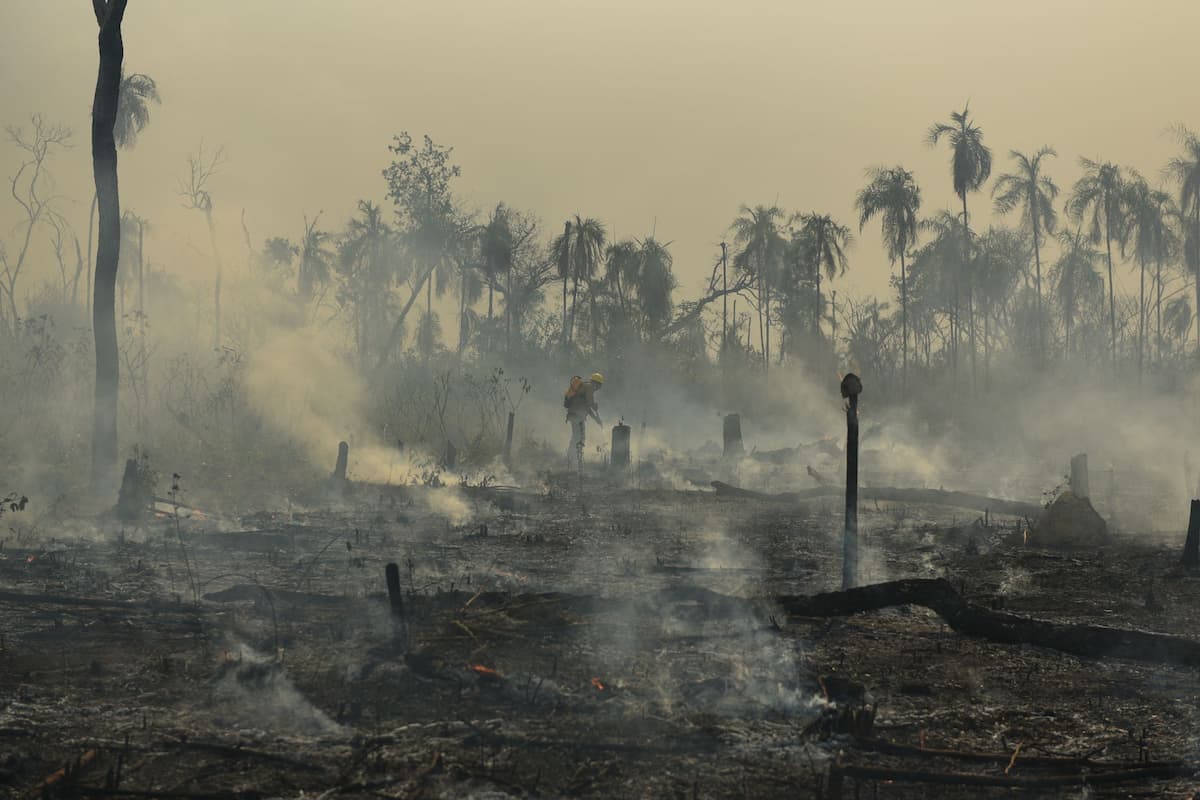
The month of August has historically been marked by outbreaks of forest fires in the Amazon. In view of this, the Ecological Research Institute (IPÊ) is building a federal volunteer strategy for Integrated Fire Management (IFM). The aim is to encourage and structure volunteer brigades that use fire as a tool for environmental conservation in the country.
The project, called "Volunteering in Integrated Fire Management", has a national scope, with the potential to contribute to the system of conservation units (UCs) and their surroundings, indigenous lands and quilombola territories, as well as landscape integrating elements such as legal reserves and permanent preservation areas, within the scope of private properties.
A survey carried out by IPÊ, from January to May this year, has so far identified 160 volunteer brigades aimed at preventing and fighting forest fires in Brazil, as well as several other institutions that work to support volunteers in activities related to Integrated Fire Management. Most of these groups are concentrated in the states of Minas Gerais, Bahia and Amazonas.
In addition to the volunteer brigades, hundreds of volunteers were also identified who work individually or collectively in various activities linked to integrated fire management, such as preventing and fighting forest fires, environmental education and recovering degraded areas, among various other activities, including indigenous volunteers, riverine communities, family farmers, extractivists and quilombolas.
In the survey carried out by IPÊ, the largest number of individual volunteers took part in Minas Gerais, the Federal District and the Arco do Desmatamento region, in Amazonas and Pará."IPÊ believes in volunteering as a strategy for engaging and involving society in conserving biodiversity and tackling climate challenges. Bringing together representatives of the government, civil society and volunteers to discuss the current scenario of integrated fire management is essential to recognizing the positive impact of these initiatives," says Angela Pellin, coordinator of IPÊ's Volunteering in Integrated Fire Management project.
Rodrigo Agostinho, president of Ibama, says that the IPÊ project is a way of giving visibility to volunteer initiatives in MIF throughout Brazil. "We need people to understand the importance of this type of management for forest conservation. That's why we support and encourage spaces like this, which help us to understand more about the dynamics, functionality and context of fire management for the environment," says Agostinho.
Data from the National Institute for Space Research (INPE) shows that June was the month with the highest number of fires in the Amazon and Cerrado in the last 16 years. In the Amazon Rainforest, 3,075 fires were recorded last month. The number is only exceeded by 2007, when 3,519 fires were recorded. In June last year, Inpe recorded 2,562 fires, which represents an increase of 37% between June 2022 and June 2023.
The initiative is in line with relevant national policies, programs and instruments, such as: the National Environmental Policy, the revised Forest Code, the National System of Conservation Units (SNUC), the National Policy for Territorial and Environmental Management of Indigenous Lands (PNGATI), the National Plan for Protected Areas (PNAP), Law 9. 608/1998, which provides for voluntary service, as well as the Bill establishing the National Integrated Fire Management Policy, currently being discussed in the Federal Senate.
Integrated Fire Management
Integrated Fire Management (IFM) is an approach that involves ecological, cultural, socio-economic and technical aspects related to fire in order to minimize damage and maximize benefits to natural environments and local populations.IFM combines technical and scientific knowledge with the traditional knowledge of communities that have managed fire for generations for food production, hunting, religious rituals and fire prevention and fighting.
Integrated Fire Management also helps to reduce emissions of atmospheric pollutants by reducing the quantity and intensity of fires and increasing the efficiency of firefighting, consequently contributing to the conservation of biodiversity and areas used by traditional populations.