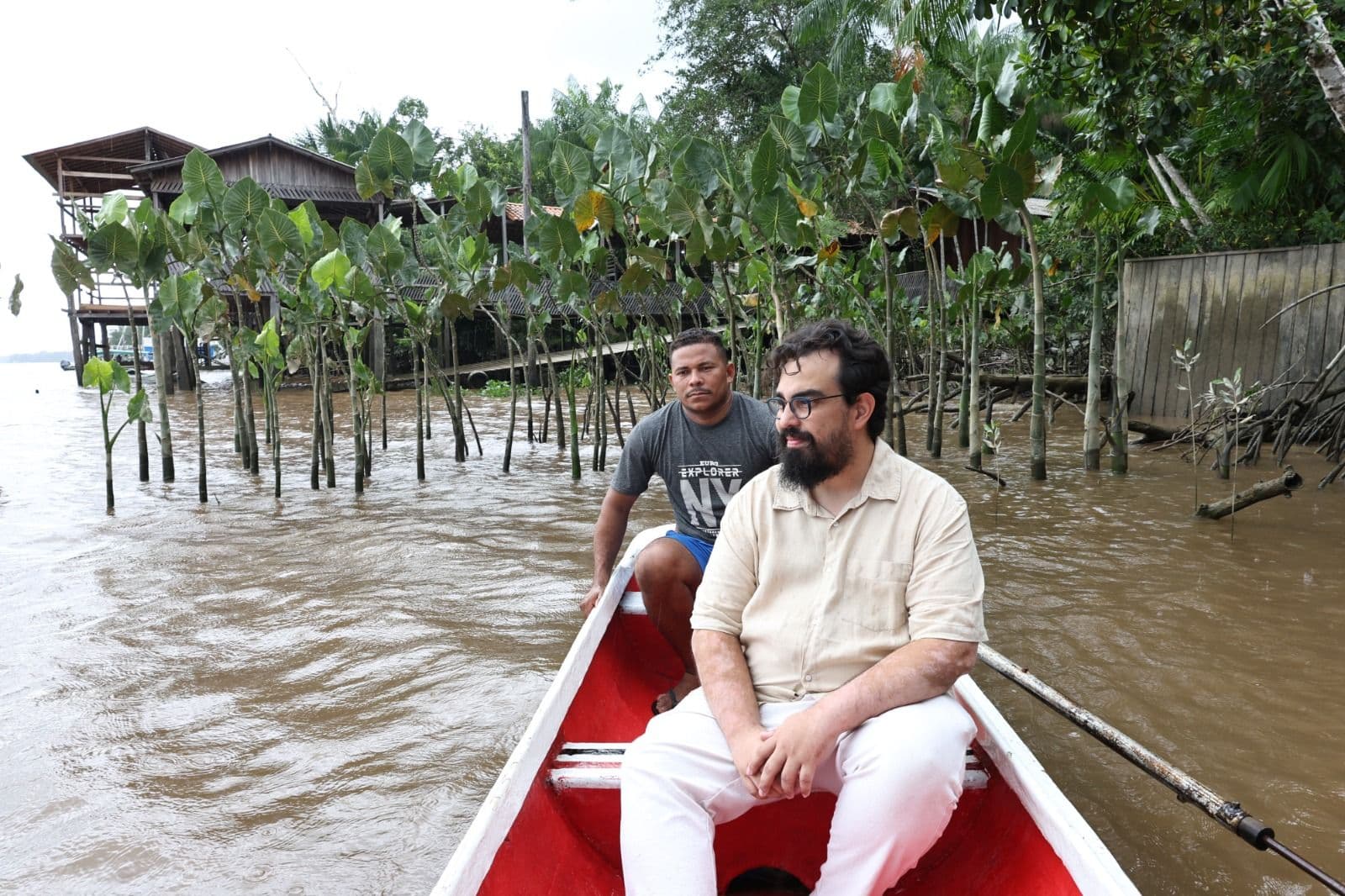
The styles, shapes, details, ideas, and knowledge produced by riverine carpenters from the islands of Pará are gaining prominence within the local and national markets. There are houses, restaurant structures, furniture, different types of braided roofs, and paintings that have a particular and unique touch by the residents of the region. Something that was previously unknown and retained on the banks of the river, today is seen as a way to ensure local development with income generation, visibility to art produced in the Amazon, and conservation of the environment.
The starting point for this change was a research project by two architects from Pará who have been documenting and cataloging the material production mode of these workers for three years. Pablo do Vale and Luís Guedes, owners of an architecture firm located in Belém, Pará, are responsible for the initiative. The idea came from the need for a creative restructuring, which led them to visit the islands of the capital of Pará in search of deepening knowledge about the local culture. The details made by the carpenters in each construction were fundamental in this process.

Valorizations
The goal of the project called Carpenters of the Amazon is to value these workers in the area. Many of them did not have this job recognized and needed a second income alternative, such as fishing, to ensure family support. In addition, the knowledge, which is passed on orally, was already being lost among the younger generations, who gradually began to show a lack of interest in learning about the activity. In this way, Luis and Pablo began to document each style of structure that is developed on the islands, actively searching for the residents and understanding their way of production.
This material will become a documentary to promote visibility to Amazon carpentry and stimulate new generations. During the research period, the architects established a headquarters on Murutucu Island - each carpenter was responsible for building a part of the house, making the space diverse and with the local identity that was intended. Luís Guedes explains that the place became an environment for exchanging knowledge and learning about the work developed in the region since each of the workers was able to express their style in the laboratories created.
"After we started researching, we made several trips to Combu Island, photographing these riverside houses that inspired us. Our architecture is based on our research, on the search for the Amazonian DNA that is represented by the riverine people, in our opinion. Our reference is the Combu Island. When we decided to make this change, we noticed scarce documentation and few people talking about it. We wanted to do it deeply, by understanding the carpenters and looking for techniques they already knew, but had never worked with. Due to the regional technique laboratory, we rescued knowledge that was being lost,” he says.
Income generation and visibility for Amazon carpenters
The documentation of the techniques and stories of the riverine people is not the only focus of the architects. Pablo and Luís also thought about a way to generate income for these workers and finance social issues related to them. Then, the Project Pallas was created. The project consists of a collection of furniture produced collaboratively between designers who are already known in the national scenario and the Amazonian carpenters. "The furniture will be industrialized by a local industry, which is the first in Brazil to receive authorization to use the residue of wood that the traditional industry rejects", highlights Luís.
For a year and a half, Pallas has been combining local wisdom with contemporary techniques already used by the four invited designers (Bel Lobo, Jay Boggo, Gabriel Kogan, and Clara Figueiredo). Each Carpenter - there are five: Valdiley, Edson, Hoseas, Josa, and Edinaldo -, called Carpenter Master by the project, has the opportunity to put their identity on the furniture built. "The most beautiful thing about the project is that it generates funding for a series of social actions that we want to do to preserve Amazonian wood so that new generations become interested in making carpentry. It is a project of visibility, of local empowerment".

Collaboration
Pallas' first collaboration was developed in a partnership of the architects responsible for the project with Master Josa. The furniture produced was a coffee table. The piece featured ornaments that are part of the carpenter's daily work. Pablo do Vale points out that the experience was a true way of understanding the buildings and styles of each of the riverine carpenters who participated in the project, as well as a way to provide visibility. "Carpenters are true architects, designers, artists, builders, and they are the examples that someone does not need to have formal education to be recognized".
"They have a knowledge that transcends this issue of studying. They usually learn from parents, from grandparents, who already worked with this kind of subject. It is an architecture with a lot of detail, more than a minimalist architecture, but it is a detailed, refined, well-done work”, completes Pablo. "Some people just want to usurp, they don't want to know the pain of others. So, we bought a house at Murutucu Island and began to make this relationship with people from the region and with carpenters”, says the architect.
Royalties from the project will be equally distributed
Every piece that is sold will generate a royalty, which will be equally paid to the designer and the carpenter. However, Pallas establishes that the invited professional must donate 50% of the received payment to the project. "This is intended to spread Amazonian carpentry and their work. In the future, the amount collected will help us to exhibit the works and make excursions in the region to present the work so that they can be viewed. The carpenters will not need to work for others to be able to support themselves", completes Pablo.

The success of the project has already reached national projection. Pallas was selected to participate in one of the largest design fairs in Brazil, The Design Week, in São Paulo. “We intend to spread Amazonian carpentry, give lectures about Amazonian riverine architecture, have a course about Amazonian Carpentry included in the curriculum of Faculties of Architecture in the region... it is this awareness that makes us bring culture and work. Our job is to spread, to bring to people's knowledge things that are not seen. The Pallas is the first step we take to start a possible return [to the carpenters]”, he points out.
Inspiration
More than bringing knowledge to architects and designers, the carpenters who were part of the project also had the chance to make other people learn the techniques developed over the years, perpetuating the activity. Isaac Monteiro, a 29-year-old fisherman, was one of them. He says that he began to be inspired by the work of one of the Pallas' Carpenter Masters to renovate the house in which he lives with his family, Murutucu Island. “My house was normal. Like any other here, it followed a standard. Then Edson [a project participant] arrived and innovated, making other models of houses”.

Isaac learned from his uncle the techniques he knows. However, he does not intend to devote himself exclusively to carpentry. For him, a second source of income is needed to complete the maintenance of the family. "Whenever some job appears, we do it. We do a little bit of everything in carpentry. I really enjoy working with it. I have learned, but I do not intend to continue. I can't stay with only this job. I'm looking for other things to complement”, he highlights.

Carpenter Masters establish an environment of mutual exchanges
Someone who also has a lot to share about mutual learning is Master Edinaldo da Silva, 58 years old. During practices in Pallas' laboratories, he met Master Oseas, who taught him leaf braiding techniques. In return, Edinaldo taught how to work with roundish structures. The result was a room in the project headquarters that had a thatched roof, floor, wood stove, and a table. "After the Pallas Project, more jobs appeared. Now, people have to schedule a request" he celebrates.
The knowledge of Master Edinaldo came from the observation of other works. Currently, two of his children act together in the works - a practice that has been done since they were very young. "My kids have been working with me since they were young. I didn't like carpentry a lot, I liked it more to be in the bushwood. But looking at others, we keep learning, we learn from our mistakes. I said some details were wrong and I could do them better. It takes time, but we do more detailed work" he says.

For Edinaldo, the Pallas experience was totally different from anything he had ever done. It was a real open door to achieve more visibility. In the project, he developed a chair with the architects Pablo and Luís, making his identity evident through the diagonal structures. "I have no practice at constructing chairs, but I took the project and did it. It was even fast. I like to make some curvy details. On the day [he made the furniture], it was totally different. It's being a success. Now I don't stop. I have a work here [at Murutucu Island]. Another one at Combu Island and I did another one recently”, concludes the Carpenter Master.