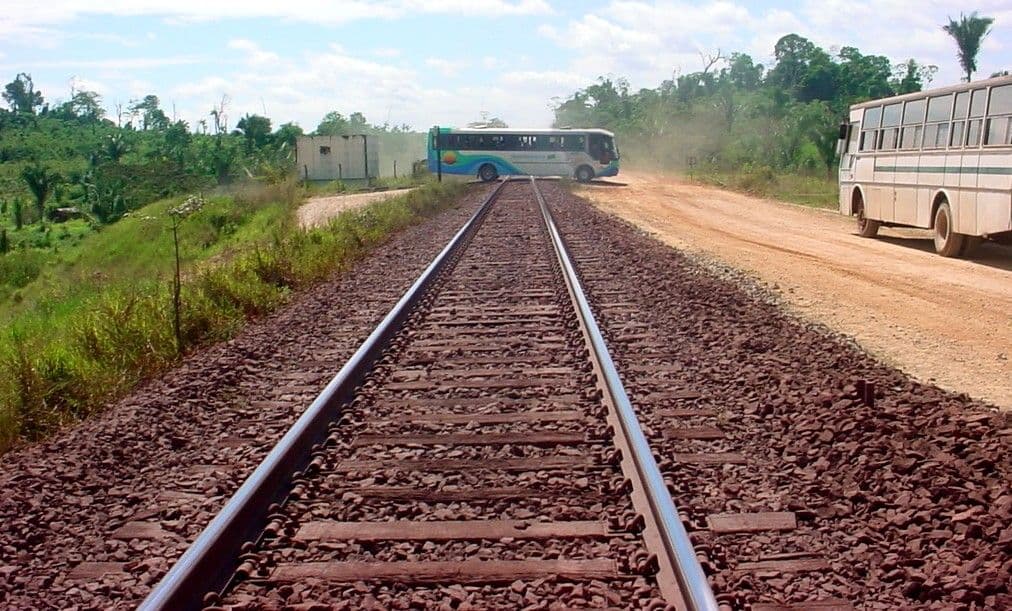
Pará railway [Ferrovia Paraense] is a project underway for at least six years in the Amazon. It has the ambition of boosting agribusiness and mining economies. The project gained momentum this year with the guarantee of US$ 2 billion in necessary investments – which means that productive sectors in the region are already drawing up prospects so that, soon, the railway project can finally be taken off the ground. The idea consists of a railway – initially thought to be 1,319 kilometers long – crossing 23 municipalities in the State of Pará alone. A company from China, the main consumer of the region’s minerals, has already indicated interest in the construction, which should connect the south of the state to one of the main Brazilian ports for export, in the municipality of Barcarena, in Pará.
The enterprise, which was designed over the long term and exceeded government mandates, does not provide for the transport of people. It will only serve the flow of agro-mineral products. The first Relatório de Impacto Ambiental (RIMA) [Environmental Impact Report] regarding the railway project dates back to 2017 and was already under elaboration by the Secretaria de Estado de Desenvolvimento Econômico, Mineração e Energia do Pará (Sedeme) [State Secretariat for Economic Development, Mining and Energy of Pará], and was recently transferred to the Secretaria de Transportes (Setran) [Transport Secretariat].
"The initial outline begins in the municipality of Barcarena, from where it continues until it crosses the palm production region, in a south-southeast direction, crossing the municipalities of Paragominas, a bauxite/alumina producer, and Rondon do Pará, a soybean producer. More towards the south, it runs from Marabá to Santana do Araguaia, in the south of Pará, a soybean-producing municipality. The route has three sidings and five railway stations. The sidings are located in the municipalities of Tomé-Açu, Dom Eliseu and Rondon do Pará. The stations are located in the municipalities of Barcarena, Paragominas, Rondon do Pará, Marabá and Santana do Araguaia", according to the report produced by the government, which raised the possible socio-environmental impacts of the project.
COMMUNITIES
The report on the railway project also provides details about the scenario regarding the populations that could be affected by the construction. In the municipalities through which the railway should pass, the study predicted direct and indirect impacts involving eleven communities and villages, 02 settlements with 5.459,563,50 hectares and 123 families, in addition to three camps with 528 families, 189 farms and seven quilombola communities, covering an area of 34,942.01 hectares.

The document also mentions that, “after consultation with the Fundação Nacional do Índio (Funai) [National Indian Foundation]” – currently Fundação Nacional dos Povos Indígenas [National Foundation for Indigenous Peoples] – “it was found that there was no interference in demarcated Indigenous Lands, nor in communities in the demarcation phase, within the limit 10 kilometers from the project". However, in August 2022, the Federal Public Ministry (MPF) established a procedure in order to monitor environmental licensing and the impacts of the railway on the Terra Indígena Las Casas [Las Casas Indigenous Land], belonging to the Kayapó people, in the city of Pau D 'Arco, in Pará. The movement took place following a meeting held in March 2018, when indigenous leaders indicated that the railway would pass just three kilometers from the traditional community.
In response and in conformity with the MPF procedure, Sedeme informed, in July 2021, that there was no Indigenous Land close to the radius of the railway route. Funai even indicated the presence of Indigenous Lands at distances greater than the railway's ten-kilometer limit: in Nova Jacundá (12 kilometers), Mãe Maria (12 kilometers), Las Casas (13 kilometers), Tembé (13 kilometers), Sarauá (14 kilometers) and Barreirinha (17 kilometers).
A letter from Secretaria de Meio Ambiente (Semas) [Secretariat of the Environment], from 2019, mentioned a technical note pointing out the lack of overlap between military areas, Indigenous Lands and Conservation Units. On the other hand, Semas indicated that the railway design would be close to quilombola communities in Centro Ouro (5.07 kilometers); Piratuba byway (5.18 kilometers); São Sebastião (7.92 kilometers); Santa Luzia do Traquateua (9.70 kilometers); and Santa Maria do Traquateua (9.98 kilometers).
Thus, a new project layout was delivered in 2021 with adjustments made by the government not only to the design, but also to the size of the railway. In July of that same year, a technical opinion from Sedeme informed that Pará Railway would be half the initial design (515.02 kilometers).
CHINESE INVESTMENT
Sedeme announced the creation of a working group by the state government to carry out prior, free and informed consultations with traditional peoples and populations. Since then, the project has been presented in municipalities throughout Pará and even to Chinese investors, in search of agreements and support.
In April 2023, an agreement memorandum was signed between the governor of Pará, Helder Barbalho, the executive vice-president of Corporate and Institutional Affairs of the Vale company, Alexandre Silva D'Ambrosio, and a representative of the largest Chinese construction company, Communications Construction Company (CCCC), Sun Liqiang. The document demonstrates the Chinese intention to invest in the construction of the Pará Railway, integrating Marabá with the port of Vila do Conde, in Barcarena, with investments expected at US$2 billion, that is, R$10 billion. “This project fosters development, adds logistics to our State, develops our economy and creates more jobs for our population”, evaluates Helder Barbalho at the time of signing.
Vale, an important mining company – with extraction projects in Pará – announced its commitment to drawing up new sections of the railway, aiming to connect the region of Marabá to the Port of Vila do Conde, in Barcarena. According to Vale, the project should consume most of the nearly R$3 billion promised by the company to the parliamentary committee of the Assembleia Legislativa do Pará (Alepa) [Legislative Assembly of Pará], which focuses on the company's activities in the Pará.

For China, investments in the Amazon are strategic
Pará is a Brazilian power regarding mineral exports, according to data from the recently published "Boletim Indústria Mineral do Pará" [Mineral Industry Bulletin of Pará], released in 2022 by the Sindicato das Indústrias Minerais (Simineral) [Mineral Industries Union], 84% of Pará's export products are minerals. The sector generated US$18.1 billion last year alone, with China as the main buyer. Business with the Asian country alone generated US$10 billion, in the acquisition of 119.9 million tons, mainly of iron ores.
Tiago Veloso dos Santos, professor and researcher at the Federal Institute of Pará (IFPA), confirms: China is not just a major buyer of agricultural and mineral products. Since the 2010s, the country has made major investments in logistics in several other regions of the planet – and the Amazon is an example. In the case of Pará Railway, explains Veloso, China's entry into the logistics chain with a project of this scale changes the country's role in Brazil. “In addition to being a buyer, China then becomes an important investor in this logistics sector, which affects production in the agricultural and mineral sectors in the Amazon region,” he details.
Veloso also states that investments in a railroad in the Amazon would be a way for China to guarantee access to products. "It's like investment diplomacy. That is, they invest in certain regions of the world to guarantee their presence there. This could have a lot of diplomatic political importance for the Chinese, as this would be an important factor in China's need to invest their accumulated capital, since China is a great power, competing for hegemony with the United States. That's why the country makes its public and private companies invest", he ponders.
OPPORTUNITIES FOR AGRICULTURE

Since Pará is a state of continental dimensions, and still marked by logistical transport deficiencies and insufficiencies, the agribusiness sector considers the railway as an opportunity to increase the circulation of goods and boost exports to the world, as explained by the advisor technician from the Federação da Agricultura e Pecuária do Pará (Faepa) [Federation of Agriculture and Livestock of Pará], Eliana Zacca. She points out that Pará is a logistical power in Latin America, as the closest base for the United States, Europe and Asia. Pará has a waterway network with eight river basins, 48 thousand kilometers of navigable rivers, which, according to Zacca, still need to be better used.
"The doubling of the Panama Canal helps Pará to consolidate as the best commercial route for Brazilian agribusiness, along with the main global consumer markets, through two axes – the Tapajós River/BR-163 and the Tocantins River/BR-158 /155. Due to the increase in national grain production, Arco Norte, formed by the ports of Itacoatiara, in Amazonas, Itaqui, in Maranhão, Santarém and Barcarena, in Pará, and Ilhéus, in Bahia, is consolidated as one of the most important flow corridors for the country's exports".
Zacca highlights that the productive sector in Pará has grown and diversified, mainly in the agricultural and mineral sectors, "however there is not enough expansion of the transport infrastructure". "There is repressed demand for transport infrastructure that requires increasing investments in this area, especially those that include intermodal transport, as is the case with Pará Railroad and Ferrogrão, important railway axes interconnecting with the port of Barcarena".
She argues that these investments can contribute to reducing transport costs and increasing competitiveness, both in exports and those carried out by the Pará port system. "The importance of the Pará Railway is indisputable, as it will allow the connection of one of the most dynamic economic regions in the State, with significant agricultural and mineral production, to the port of Vila do Conde. Furthermore, this railway has interoperability with the railroads Ferrovia Norte-Sul and Estrada de Ferro Carajás", she points out.
Project reaffirms a new generation of the Amazon agromineral economy to the world
Geographer Tiago Veloso dos Santos explains that the Pará Railway is part of a group of projects and programs that, since the 1970s, has been transforming the economy of the Amazon, especially in Pará, as a major producer of agricultural and mineral goods.
The researcher mentions that the municipality of Barcarena, the starting point of the railway, can be seen as a synthesis of these transformations. "In this city, there are large industrial mining projects and, more recently, there is the installation of a thermoelectric plant for energy production. So, we have seen the arrival of projects since the 2000s, both public and private, to expand the port of Vila do Conde”.
Veloso explains that there is also increase in private ports to serve, in addition to the flow of minerals for export, the production of agribusiness goods. "The project for this railway is kind of a new generation project to reaffirm the agri-mineral economy, due to its large scale. The Pará Railway is larger than the existing railway, named “Ferrovia de Carajás”, which connects the Serra dos Carajás , in the south of Pará, to the port of Itaqui, in the State of Maranhão", he assesses.
LOGISTICS BASE
The municipality of Barcarena is strategic for the Pará economy. Thus, in April this year, parliamentarians approved a bill that makes it part of the Belém Metropolitan Region (RMB). Its area is home to large mining projects, among other industrial activities.
Geographer Tiago Veloso recalls that the city was already part of the metropolis' space of influence due to the industrial project flows in the 1970s – and that the Metropolitan Region of Belém has been consolidating itself in the state as an important logistical market base, more recently for agribusiness. “The agribusiness economy, which was previously further away from Belém, is now closer to the capital due to the adoption of biofuel, linked to palm oil production”, he points out.
Veloso also says that the transformation of the Metropolitan Region of Belém into a logistics platform for the Amazon is not by chance. “With Barcarena now really integrated into the metropolitan region, the city that already had this investment in logistics can now be part of a whole complex, and this will intensify over time, especially if a railway connects the south of Pará to the metropolis” .