
In the face of climate change, which is causing historic droughts and ever higher temperatures in the Amazon, what will be the fate of the largest tropical forest on the planet? This is the question that a long-term study carried out by the Federal University of Pará (UFPA), the Emílio Goeldi Museum of Pará and several partner institutions, including international ones, seeks to answer.
The Drought Study in the Forest project (Esecaflor) completes 25 uninterrupted years of research in 2026, which have already yielded hundreds of articles and doctoral and master’s theses. It is the longest and most extensive study of its kind ever carried out in a tropical forest. The conclusion? The Amazon rainforest can adapt to a reduced rainfall regime, but with profound changes to the characteristics it has today.
The investigation takes place in the Caxiuanã National Forest, located in the municipality of Melgaço, on Marajó Island, in Pará. It is one of the many studies carried out at the Ferreira Penna Scientific Station, a research base of the Goeldi Museum. The national coordinator of the experiment is the meteorologist Antonio Lôla da Costa. The international coordination is in the hands of Professor Patrick Meir, of the University of Edinburgh, in Scotland.
“Thirty years ago it was already being said that, if climate change persisted, the planet’s temperature would rise and rainfall would decrease. So we decided to study, in practice, what those climate change models predicted. We wanted to understand what the Amazon’s response to this would be,” explains Lôla, a retired professor at UFPA, volunteer researcher at the Goeldi Museum and one of the creators of Esecaflor.
Structure prevents the area from receiving half of the rain
According to João de Athaydes Silva Júnior, also a meteorologist and researcher on the project, Esecaflor aims to understand the effects of reduced rainfall on the vegetation of the Amazon’s dryland woods. “The project is the result of an international partnership between universities and research centers in Europe and UFPA, and it also includes researchers from other national institutions. The study arose to contribute to understanding the real effects of reduced rainfall on forest vegetation, and the results are used to help calibrate weather and future climate models. Initially, the project was going to be short-term, but, with the interesting results that began to emerge, it ended up lasting longer and reaching the present day,” he says.
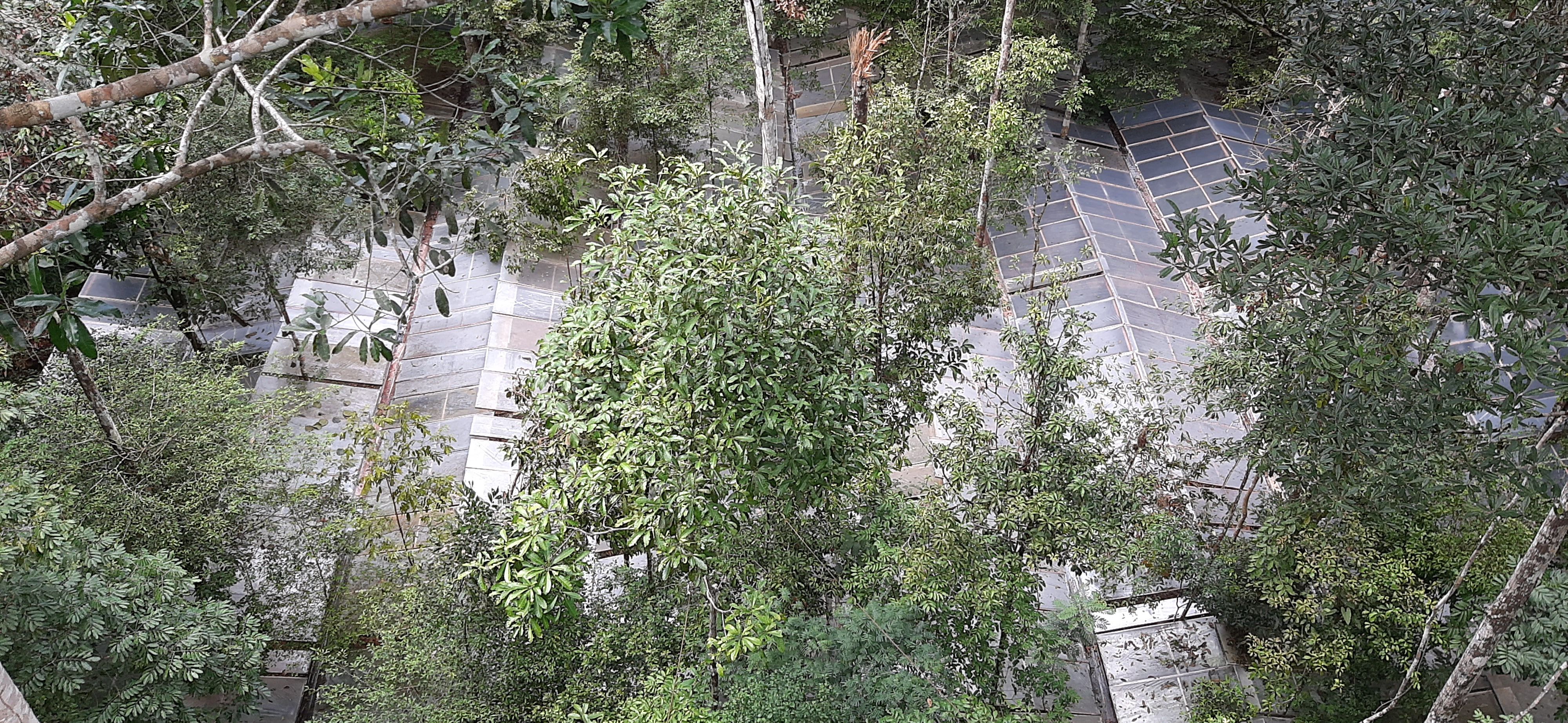
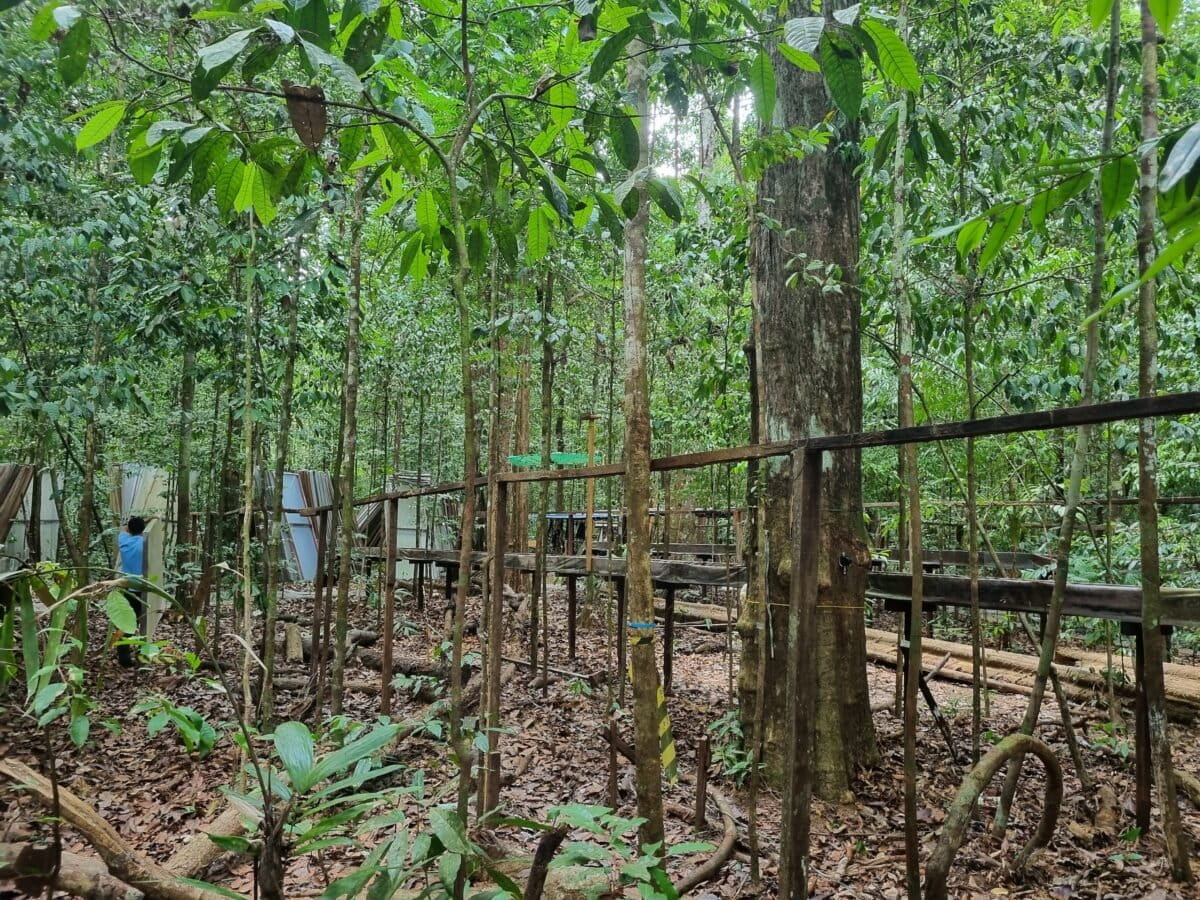
Athaydes explains how the experiment was developed. “The project was designed with two plots of one hectare each. One plot would receive a structure to exclude part of the precipitation and the other would continue receiving rain without human interference. In both plots, various instruments were installed to monitor meteorological, soil and vegetation variables. Two 40-meter towers were installed, one per plot, where meteorological elements are measured from the top down to near the ground, in addition to other physiological measurements and observations. In the soil, there are wells for monitoring the soil moisture profile, where other studies are also carried out,” the researcher details.
Lôla adds: “One plot of ten thousand square meters receives normal rain, for comparison, and the other ten thousand square meters receive only 50% of the rain. We built a structure made up of six thousand plastic panels, a kind of roof, and the rain falls on this roof and a gutter drains all this water into a ditch. By gravity, this water is thrown out of the plot that receives only half of the rain. We take several simultaneous measurements and the differences are attributed precisely to this climate impact.”
The researcher highlights that several monitoring activities are carried out in both plots. “We check biomass growth, sap flow, carbon flux, soil carbon flux, soil temperature and moisture, air temperature and humidity. In other words, we monitor a huge range of variables,” he points out.
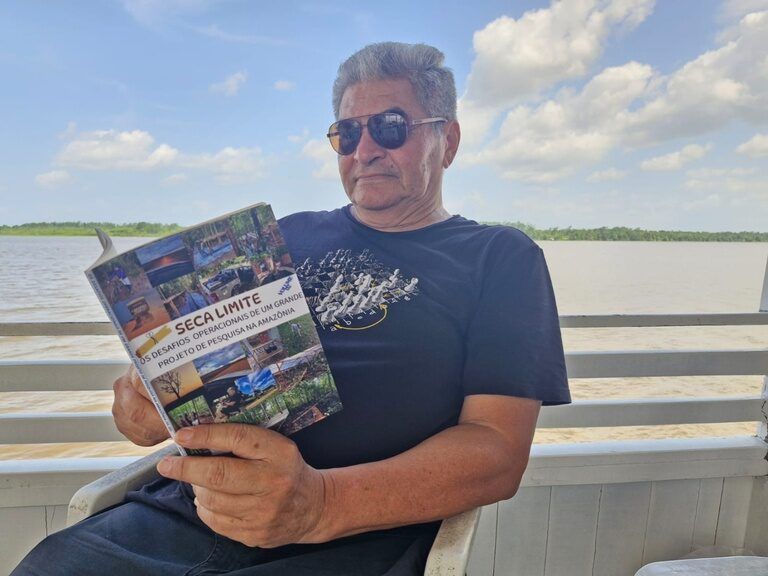
Athaydes has also worked on the project since its beginnings and is now the national deputy coordinator. “I started in 2001, as an undergraduate research student, together with Professor Antônio Lôla, while studying for my degree in Meteorology. In my master’s, I worked with data that I was able to collect in the field in this research. Then, as a UFPA professor, I resumed activities at Esecaflor, being able to dedicate more time to them. As a meteorologist, I contribute with the instrumentation that carries out the monitoring and with the study of micrometeorological interactions with the forest in the two plots,” he says.
The forest showed resilience, but also significant changes
For 23 years the plot received 50% less water. The studied plot suffered water stress and this part of the forest had to readapt, redistributing the little water available in the soil in order to reach a new local hydrological balance. However, these changes had impacts: besides the change in the hydrological cycle itself and also in the carbon cycle, the forest became shorter, less dense and with less biomass, such as leaves, branches, trunks and roots. With these new characteristics, its capacity to store carbon dioxide, the main greenhouse gas, became smaller.
Lôla recalls how everything unfolded over the years of study. “In the first years, nothing happened, because the forest soil was still very moist. Then, within the first five years, mortality began, mainly of large trees. After eight years of the experiment, we had lost 40% of the biomass. At fifteen years, mortality was even greater. So we stopped to analyze what would happen: whether the forest would collapse or whether it would resist. And we made another experimental design precisely to follow this reaction. We observed that the large trees, which need a lot of water, died, but that the little water that remained was enough for the smaller trees to organize themselves and start the process of resilience. In other words, the forest suffered a lot, but adapted after 15 years,” he states.
“So, the main consequence of climate change would be a reduction in the size of the forest. Before, the trees were 40, 45 meters tall. If these impacts persist, it will be a forest of 20, 25 meters,” adds the coordinator.
Consequences are global
Lôla emphasizes that the impacts of this change would not be only local, in the Amazon rainforest itself. “This will imply global changes, that is, it will change the entire hydrological cycle and the carbon cycle. And what is already happening today, with more intense droughts, storms, hurricanes, tornadoes, that is, adverse weather phenomena, will tend to be intensified. If there is less forest, less carbon will be absorbed, that is, the greenhouse effect will be amplified. This means that human beings throw out pollution, the forest removes less pollution, pollution will be left over in the atmosphere and the greenhouse effect will keep increasing. Our temperatures will keep rising, up to a limit that will become unbearable. Unfortunately, it is a very catastrophic projection, but a realistic one,” laments the professor.
The coordinator of Esecaflor recalls that the change in the hydrological cycle will affect the so-called flying rivers of the Amazon, which carry rain to other parts of the country, which is fundamental for agricultural production and water supply in those regions. “To give you an idea, each square meter of Amazon rainforest sends four liters of water into the atmosphere per day. So, multiply four times 5.6 million square kilometers of forest. If this reduction in the size of the trees happens, these flying rivers will be cut in half. Other, non-Amazonian regions will become more arid, there will be a lack of water in many places, and, with less water, the temperature will be higher,” he warns.
New phase of the study
Esecaflor has existed for 25 years, but in only 23 of them was access to rain restricted in one of the plots. Deputy coordinator Athaydes points out that the project is in a new phase. “At the end of 2024, the rain exclusion cover was removed, so that we can understand what the response of the forest that went through prolonged water stress will be. For this, monitoring continues to be carried out, so that we can try to understand whether the forest will return to its initial conditions or not, and what its new reality will be.”
Lôla explains that the exclusion plot went back to receiving all the rainfall, like the control plot. “It went back to being as it was before, receiving the same rain. Only, because it spent a long time being stressed, everything changed: sap flow, carbon flux, soil temperature and moisture, water potential. Now, little by little, the forest is reorganizing itself, and we think that at some point it may come to match the plot that suffered no impact. So, what we want now is to know how long it will take to react, to return to its initial state,” he reports.
But the meteorologist warns that this may take a long time. One of the doubts is whether large and symbolic species of the region, such as samaumeira [kapok], andirobeira [andiroba] and angelim-vermelho [red angelim], will be able to grow again in this new environment.
“Obviously it will take a long time, because those very large trees practically all died, and for even the small ones to reach their size, it really takes decades, and this can be projected in a longer-term study. What we want to know is how this more immediate reaction is going. Since 2024, we have been studying the forest’s resilience, how fast this restoration will be, which species will survive. In other words, we are now studying in detail the forest’s response after it suffered a major impact and that impact ceased. There are still many questions to be answered.”
INSTITUTIONAL PARTNERSHIP
The production of Liberal Amazon is one of the initiatives of the Technical Cooperation Agreement between the Liberal Group and the Federal University of Pará. The articles involving research from UFPA are revised by professionals from the academy. The translation of the content is also provided by the agreement, through the research project ET-Multi: Translation Studies: multifaces and multisemiotics.


